Whenever I look at mountains that are in my path, the ones that stand between me and my desired goal, I think of others who have overcome seemingly immovable obstacles. And those thoughts always lead me to Moses.
The great prophet Moses was given stewardship over the children of Israel—he was to lead them out of captivity in Egypt and take them through the desert to the promised land. That sounds pretty daunting to me, and perhaps it might have felt the same to Moses. But in fulfilling that stewardship, Moses taught us all two lessons of eternal import.
 With the children of Israel in tow, Moses led them from captivity as instructed by the Lord. But the Egyptians were not going to be easily denied. Fast on Moses’s heels, Pharaoh’s army approached with gathering speed, determined to capture their former slaves.
The chase was on, and Moses and the children of Israel were maintaining a shaky but decisive lead. Then it happened. It was the Red Sea. There Moses and his people were: towering sand dunes on every side, six hundred chariots bearing a ferocious army behind them, and nothing but a lot of water in front of them.
Moses needed to know how to get himself and the children of Israel out of that mess, through that water, and he needed to know how right then. It was a matter of life and death. I cannot imagine following him—seeing up ahead the lapping waters of a sea in which all would surely drown, hearing behind me the sound of pounding hoofs, the roaring wheels of a myriad of chariots, and the shouts of hundreds of Egyptian soldiers. There was no escape. Death and destruction were imminent. Or so it seemed.
 That’s where the first lesson comes in. In their terror, the children of Israel turned on their prophet and deliverer. Can’t you just hear it? The scriptures use different language, but the children of Israel basically said, “What on earth were you thinking? This isn’t worth it. It would be better to be slaves to the Egyptians than to drown in the sea or die in the wilderness. We don’t think this was the right decision. Let’s go back.” But that wasn’t an option.
The faith of every one of the Israelites was being tested. They were heading straight into a sea, and there was nowhere else to go. But Moses knew, and they would eventually know, that it was not better to stay in captivity to the Egyptians. He told the children of Israel, “Fear ye not, stand still, and see the salvation of the Lord” (Exodus 14:13). They did. And oh, what they saw.
How many times are we led in ways that don’t seem quite right? How many times are we unable to see what’s ahead—and in our shortsightedness, unable to trust in what we’re being told? How we’re being led?
And that’s where the second lesson comes in. I can’t even imagine what Moses must have been thinking. Maybe the Lord put that mountain—that sea—in Moses’s path to show him that it could be moved. Or maybe the Lord put that mountain in Moses’s path to show the children of Israel that it could be moved. Maybe it was both. The Lord knew Moses could do it. But just as with you and me, Moses needed to know he could do it.
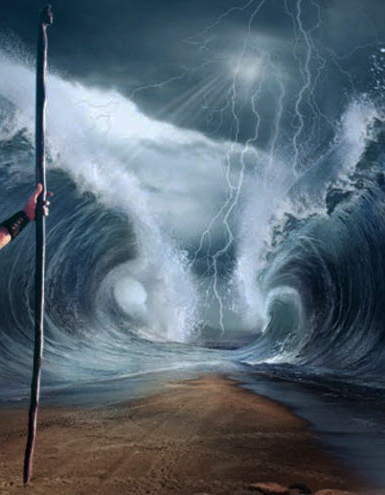 You know the story. Moses and his people came to an abrupt halt on the seashore, where he turned to the Lord in prayer. And the Lord told him what to do. Moses needed merely to lift his rod and stretch his hand out over the sea, and the Lord would divide it so the children of Israel could walk through the sea on dry ground. Could it be? Maybe you and I would have faltered a bit at that. On the face of it, that seemed impossible. But not Moses.
You know what happened next—one of the greatest miracles in recorded history. Moses lifted his rod, stretched his hand out over the sea, and the waters receded, exposing dry land. He led the children of Israel through the sea on that dry ground. The waters were like great walls on either side of them; what a magnificent spectacle! No one had ever crossed the Red Sea like Moses and the children of Israel did. So what? They did, and in doing so taught us in a way words never could.
Now imagine the surprise of the Egyptians who were charging in after Moses and the children of Israel. That included not only all of the soldiers, but all of Pharaoh’s horses and chariots. But the Lord again instructed Moses, who stretched out his hand over the sea once more. With the children of Israel safely on the opposite shore, the waters started to come down in their strength. The Egyptians saw that and tried to turn back, but they were too late. The Lord “overthrew the Egyptians in the midst of the sea,” covering the chariots and the horsemen and all the host of Pharaoh in the deep water (Exodus 14:27). There wasn’t a single survivor.
Next time you’re faced with a mountain that seems too massive or menacing to conquer, remember Moses. And next time you’re instructed to follow in a way that doesn’t seem to make sense, remember the children of Israel. And as you do both, prepare to move that mountain or to walk through that sea on dry land. Because miracles still happen, for all of us.